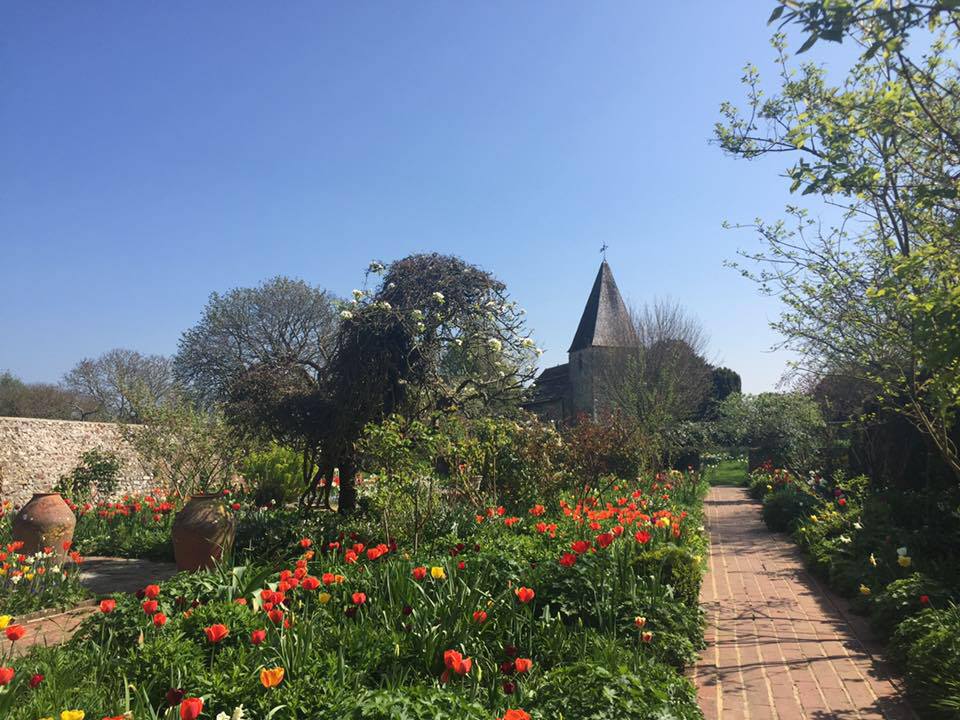
April 8, 2017. I took the train down from London to visit Monk’s House, where Virginia Woolf was living at the time of her death. Before my trip, I had read that the house was soon to be closed temporarily to visitors for restorations. Visiting that house was very high on my bucket list, even though Woolf would have likely turned her nose up at such pilgrimages, not that she would be there, given the aforementioned death and all. I decided to go at once for fear that the renovations would somehow cause a fire or flood, and the house would be lost. I felt such inexplicable urgency about it. Despite having no money to spare, my husband then a full-time student, I bought a ticket to fly to London from Boston. It was a beautiful, sunny spring day, warm and perfect as it always should be but rarely is. The gardens at the house were in full bloom and more expansive than I’d ever imagined. I would never forget this moment of April. After years of dreaming of this visit, I was finally here. I had done it. I felt unstoppable.
April 8, 2021. My grandfather died. He was in his nineties, so his death was by no means a tragedy, but all the same, I sat on my kitchen floor and cried. To be clear, I was already in the kitchen when my dad called to tell me the news. I didn’t go in there explicitly for the purpose of sitting on the floor and crying, not that there would be anything wrong with it if I had. It was a weird time: people were just starting to get vaccinated against COVID, but I wasn’t eligible yet, so in addition to grief, I felt anxiety about the funeral. I would have felt that in the best of times, though, not that funerals are ever the best of times. It was the first time I left Massachusetts in over a year; it was the first time I saw my parents in over a year as well. It was a lot to handle. I was a pallbearer, and I cried every time I had to touch the casket. My dad gave a beautiful eulogy. He told a story about a time when he and his sister got in over their heads on a home repair project. At an inopportune moment, my grandfather had walked in, and my aunt shouted, “This is all your fault, you know!” My grandfather had only just arrived; how was he to blame? My aunt explained, “You always told us we could do anything. Look where that got us!” My dad said he hoped that he made his own sons feel that way, too. He did, and he does.
April 8, 2024. My parents drove to mainland Texas for the solar eclipse. I sat on my roof deck, thousands of miles away, and read Virginia Woolf’s diary entry about the eclipse of 1927. My grandmother was three years old at the time of that eclipse, and at 100, she watched this year’s eclipse as well, unlike Virginia Woolf or my grandfather, given the aforementioned deaths and all. As my aunt graciously pointed out that day, my own parents might be dead by the next solar eclipse in 20 years. My dad is the oldest child, and I think he and my older brother would both agree that younger siblings are, as a rule, insufferable. As the light shifted, I put on my flimsy paper glasses and imagined my parents doing the same. In my mind, my parents were radiant that day, bathed in the magical golden haze, despite, or because of, my thoughts about their mortality. “How can I express the darkness?” Virginia Woolf wrote 97 years ago. “It was a sudden plunge.” Later, after the eclipse was long over and the sun had set, I sat downstairs and tried to write about the day. I felt such inexplicable urgency about it. My phone rang, and I shouted to the empty room, “I’m so tired!” But I yelled it in French, because it’s easier to be indignant in French. The phone call was from my parents; I hated to be interrupted, but how could I write of my parents while ignoring their call? My dad informed me that the sky in Texas had been cloudy; they had not seen the moment of totality after all. I felt as if we’d all been somehow cosmically spared, for how could any of us die now, never having seen the full eclipse? We would see the next one. We would live to be 100. We could do anything.
 Timothy Deer